
Planting
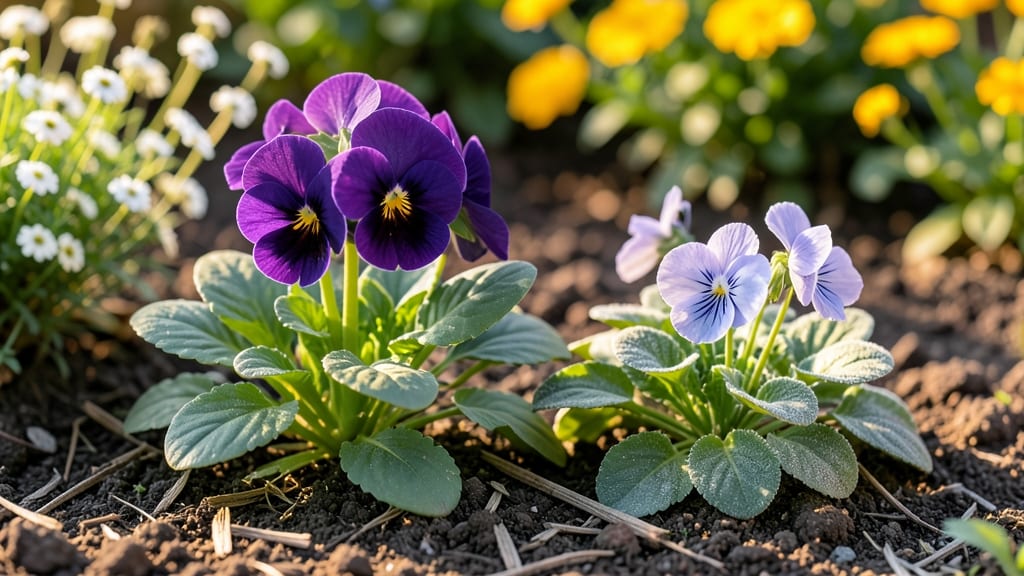
Whether viola plants are annual or perennial depends entirely on your climate zone: annuals complete their life cycle in warmer zones (7-10) after flowering, while perennials in cold-hardy zones (3-8) survive winter and regrow each spring.
This distinction comes down to how well viola roots tolerate freezing temperatures.
Perennial varieties develop deep root systems that remain dormant during winter, while annuals in warmer climates simply complete their growth cycle and die back. 🌱 The key difference is their ability to withstand frost—perennials bounce back from root systems, while annuals rely on seasonal replanting for continuous blooms.
For gardeners in transitional zones (like 6 or 9), you might see viola plants behave as short-lived perennials—surviving mild winters but struggling through harsh freezes. This is why many gardeners in these areas opt for biennial planting strategies to get the best of both worlds.
💡 In This Article
- How Cold Hardiness Zones Determine Viola Lifespan
- Extending Viola Blooms: Annual vs Perennial Planting Strategies
How cold hardiness zones determine viola lifespan
The difference between annual and perennial violas comes down to their root systems and how they respond to temperature shifts. Perennial violas develop thick, fibrous roots that store carbohydrates during summer growth, which they convert into sugars for winter protection.
These roots can tolerate temperatures as low as -20°F to -30°F (zones 3-8), thanks to a natural antifreeze protein called "dehydrin" that prevents ice crystal formation in their cells. 🌡️ In contrast, annual violas in warmer zones (7-10) lack this cold tolerance and complete their entire life cycle in just one growing season.
Here's where the science gets fascinating: perennial violas enter a state called "endodormancy" when temperatures drop below 40°F. This isn't just dormancy—it's a metabolic shutdown where the plant's growth hormones (like gibberellins) are suppressed, and protective compounds like proline accumulate in the roots.
This process begins as early as 45°F in sensitive varieties, while hardier types may wait until 35°F. Annual violas, however, never reach this stage because their entire life strategy revolves around rapid growth and reproduction before frost.
What most gardeners overlook is how soil temperature affects this process. Even in cold zones, violas planted in south-facing beds with dark mulch may experience 5-10°F warmer soil temperatures than those in north-facing spots.
This microclimate difference can mean the difference between a viola surviving winter or behaving like an annual. The root zone needs to stay below 32°F for at least 2 weeks to trigger true dormancy in perennials—any warmer, and they'll continue growing weakly, making them vulnerable to winter dieback.
There's also a genetic component: some viola hybrids (like the 'Soraya' series) have been bred to bridge this gap, showing partial perennial behavior even in zone 6. These plants develop semi-hardy roots that can survive 5-10°F but may still die back in harsh winters.
The trade-off is they often produce more vigorous spring regrowth than true annuals. For gardeners in marginal zones, this hybrid approach offers the best of both worlds—prolonged blooms with some winter hardiness.
The frost line isn't the only factor—snow cover plays a crucial role too. A 6-inch snow blanket can insulate soil by 20°F, protecting perennial viola roots that might otherwise freeze.
This is why violas often thrive in northern climates where heavy snowfall is common, even when daytime temperatures fluctuate above freezing. In contrast, areas with freeze-thaw cycles (like zone 7) can be particularly damaging because the repeated expansion and contraction of ice crystals ruptures plant cells.
Understanding these mechanisms helps explain why some violas in zone 6 might survive one winter but not the next—it's not just about the minimum temperature, but how consistently cold the soil stays.
For true perennial behavior, roots need to experience prolonged sub-freezing temperatures (below 32°F for 4+ weeks) to fully harden. Annual violas, meanwhile, never develop this cold tolerance because their entire genetic programming is geared toward rapid reproduction before frost.