
Flowers
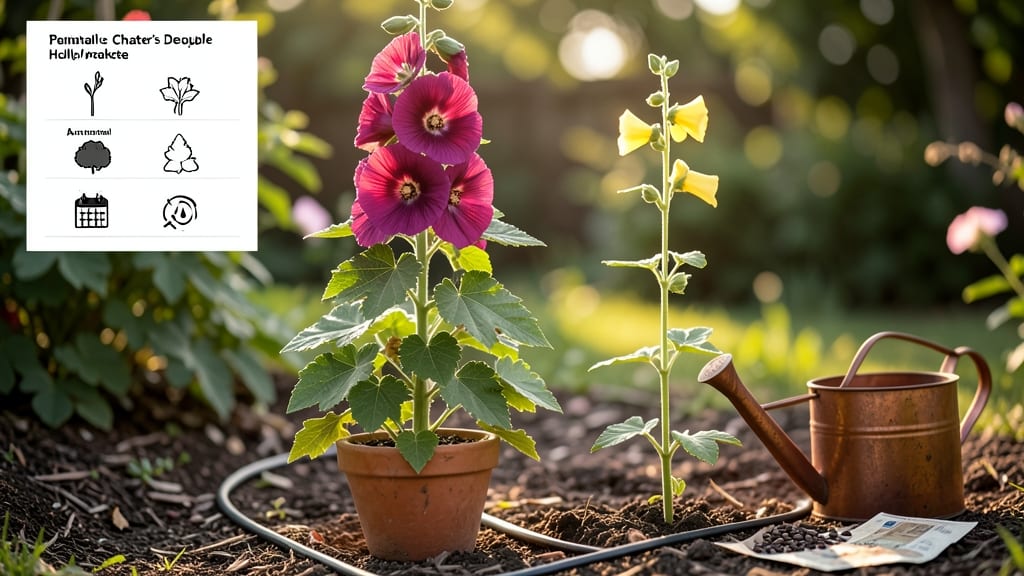
Deciding whether hollyhocks are annual or perennial depends on your climate—these plants thrive as perennials in mild regions but are often treated as annuals in colder areas where frost kills them back. Their lifespan varies by hardiness: some varieties rebound with proper winter care, while others die back completely each year, with blooms appearing in the second year before fading.
Hollyhocks' behavior shifts with temperature because their roots and stems struggle in freezing conditions. 🌱 In warmer zones (USDA 6-9), they reliably return year after year, but in colder climates (Zone 5 or below), even the hardiest types may need winter protection like thick mulch or row covers.
The key difference lies in their root systems—some varieties store enough energy to regrow, while others simply won't survive the cold without intervention.
For gardeners in frost-prone areas, the solution often comes down to variety selection and seasonal care. Hardy cultivars like 'Black Prince' can withstand colder winters with proper insulation, while tender types like 'Chater’s Double' may need to be replanted annually.
Understanding these patterns helps you choose the right hollyhocks for your growing conditions and manage expectations for their lifespan.
💡 In This Article
- Hollyhock Growth Cycles: Perennial vs. Biennial vs. Annual Behavior
- Cold-Climate Hollyhock Survival Guide: Mulching, Pruning, and Zone-Specific Care
Hollyhock growth cycles: perennial vs. biennial vs. annual behavior
The botanical identity of hollyhocks (Alcea rosea) as perennials, biennials, or annuals hinges on their root system resilience and temperature tolerance. In USDA Zones 7-9, where winters rarely drop below 10°F, hollyhocks behave as true perennials, developing deep taproots that store carbohydrates for regrowth.
These roots can survive winter dormancy, allowing the plant to emerge each spring with minimal care. The key mechanism here is cold acclimation—hollyhocks naturally harden off as temperatures drop, converting starches into sugars that protect cellular structures from freezing damage.
In colder climates (Zones 5-6), the story changes dramatically. Hollyhocks often exhibit biennial behavior, where they focus energy on root and leaf growth in their first year, then produce flowers and seeds in their second year before declining.
This shift occurs because prolonged exposure to 20°F or colder damages or kills aboveground stems, forcing the plant to rely on its root reserves. Some varieties, like 'Black Prince', have evolved thicker root crowns that can regenerate even after severe frost, while others simply won't survive without protection.
The genetic variability here is fascinating—some hollyhocks have inherited cold tolerance from wild relatives like Alcea rugosa, which thrives in Siberia's harsh winters.
What most gardeners don't realize is how soil temperature plays a critical role. Hollyhock roots need soil temps above 40°F to resume growth in spring. If winter mulch decomposes too quickly or if the ground stays frozen, the plant may appear dead when it's actually dormant.
This is why many gardeners in Zone 5 mistake hollyhocks for annuals—they see no regrowth in early spring and assume the plant is gone, when in reality, the roots might still be viable beneath the frost line. 🌱 The difference between a biennial and annual hollyhock often comes down to whether those roots can recover from winter stress.
Here's a practical way to think about it: Imagine hollyhocks as three distinct personalities based on climate. In warm zones, they're the reliable perennial that returns like clockwork. In moderate zones, they're the biennial that needs a little extra care to persist.
And in cold zones, they often behave as annuals unless you provide winter protection. The key to success lies in understanding your specific microclimate—whether you're in a sheltered urban garden (warmer) or an exposed rural plot (colder)—and choosing varieties that match your conditions.
For example, 'Chater’s Double' hollyhocks, beloved for their ruffled blooms, are particularly tender and rarely survive winters below Zone 6 without protection. Meanwhile, 'Happiness' series varieties have been bred specifically for cold tolerance, often thriving in Zone 5 with proper mulching.
This genetic diversity means you can essentially "engineer" your hollyhock's lifespan by selecting the right cultivar for your growing conditions. The science behind this involves phenotypic plasticity—how plants adjust their growth patterns in response to environmental cues like temperature and daylight hours.
One fascinating aspect of hollyhock biology is their flowering trigger. Most varieties are day-neutral, meaning they'll bloom regardless of daylight length, but their overall vigor depends on how well they've stored energy in their roots.
In colder climates, this means biennial types might produce their first flowers in their second year, then decline after seeding—hence the biennial classification. Meanwhile, perennial types in warm climates continue this cycle year after year, with some specimens living for 5-7 years if given optimal conditions.
The difference comes down to whether the plant can maintain its root reserves through winter.
To put this into perspective, consider this comparison: A hollyhock in Zone 8 might grow 5-6 feet tall and flower reliably each summer, while an identical plant in Zone 5 might only reach 3-4 feet in its first year and produce flowers in its second year before fading.
The same genetic material behaves differently because of environmental factors. This is why gardeners in colder climates often need to treat hollyhocks as annuals—they simply can't guarantee the plant will return year after year without intervention. 💫