
Plants
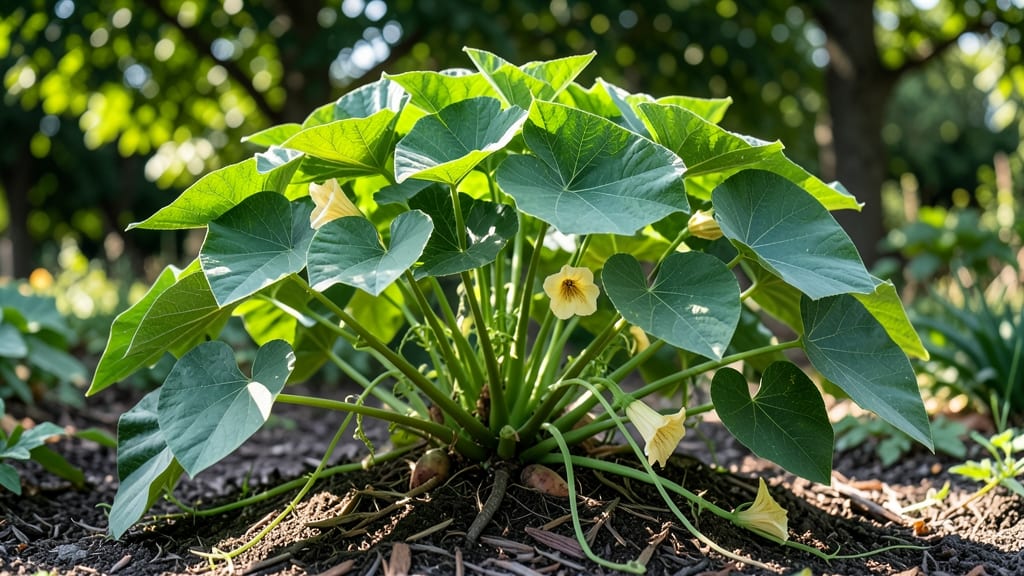
Sweet potato plants are not true perennials in most climates, though their tubers can survive mild winters underground. In frost-free zones, they regrow from stored tubers, but cold temperatures typically kill the foliage, requiring replanting each season.
Sweet potato plants behave more like seasonal growers than true perennials because their above-ground parts die back when temperatures drop. 🌱 The tubers themselves act as storage organs, storing energy to potentially sprout new shoots in warmer months—but only if they survive frost.
In colder regions, gardeners often dig and store tubers indoors until spring, treating them like annuals despite their biological resilience. This survival strategy makes them unique compared to hardy perennials that regenerate from roots year after year.
What sets them apart is their dormancy trigger: unlike true perennials, sweet potatoes rely on temperature cues to signal foliage death. When nighttime temps fall below 50°F, the plant's growth hormones shut down, sending nutrients into the tubers.
This adaptation explains why they thrive in warm climates but struggle in northern gardens without human intervention.
💡 In This Article
- Why Sweet Potato Plants Die Back in Cold Climates
- Extending Sweet Potato Growth in Different Climates
Why sweet potato plants die back in cold climates
Sweet potato plants exhibit a biological response called cold-induced dormancy, triggered when nighttime temperatures drop below 50°F. This mechanism differs from true perennials like asparagus or rhubarb, which store energy in underground crowns or rhizomes that remain alive through winter.
Instead, sweet potatoes redirect all their energy into the tubers, causing the foliage to yellow and die back—a survival strategy to protect their stored nutrients from freezing.
The key difference lies in their tuber storage physiology. True perennials maintain active growth centers underground, while sweet potatoes convert their entire above-ground biomass into starch-rich tubers. When frost hits, the plant's cellular membranes rupture in the foliage, but the tubers remain protected by their thick, insulating skin.
This is why you'll often see gardeners in Zone 8-10 areas leaving tubers in the ground—they can survive mild winters, but the foliage still dies back.
What's fascinating is how this process mirrors the behavior of biennial plants like carrots or beets, which also store energy in roots before flowering. The hormonal shift involves increased production of abscisic acid, a plant stress hormone that signals dormancy.
This is why sweet potatoes won't regrow from seed in cold climates—they've already "decided" to focus all their energy on tuber storage rather than seed production.
Consider this comparison: while rhubarb can survive -20°F winters, sweet potato tubers typically tolerate only 20-25°F before cell damage occurs.
The difference comes down to their evolutionary adaptations—rhubarb evolved in temperate climates with harsh winters, while sweet potatoes originated in tropical regions where they never needed to develop true cold hardiness.
Here's what happens at the cellular level: As temperatures drop, the plant's photosynthetic activity halts, and chlorophyll breaks down (causing the yellowing). Meanwhile, starches in the leaves are transported to the tubers via the phloem, where they're converted to insoluble starch granules that won't freeze.
This process can take 4-6 weeks once temperatures consistently drop below 60°F.
The result? A plant that appears dead above ground but may still produce new shoots from the same tubers in spring—if the tubers survived.
This is why gardeners in marginal zones (Zone 7-8) often use straw mulch (12+ inches) to insulate tubers through winter, creating a microclimate that prevents freezing.