
Flowers
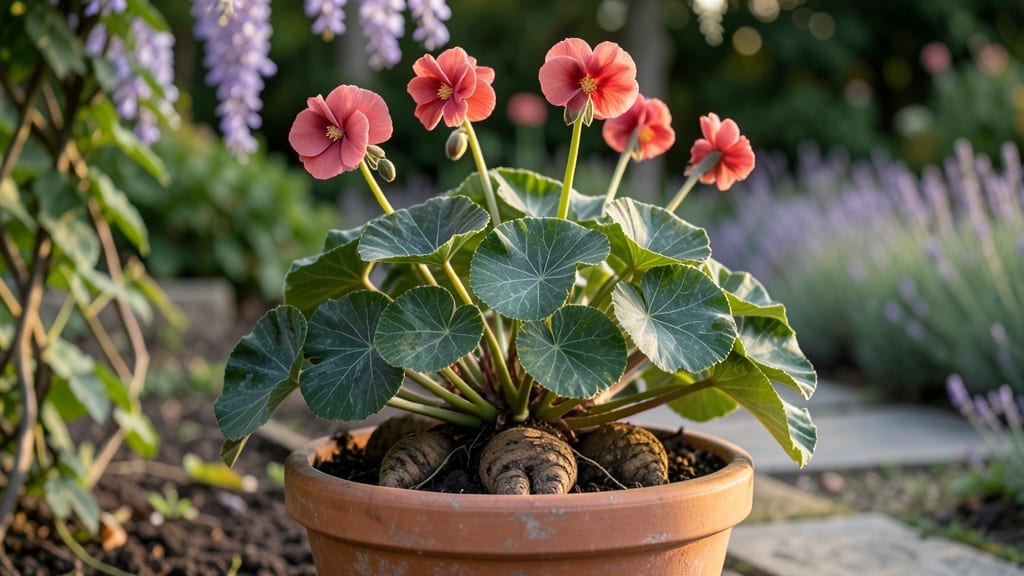
Tuberous begonia is a perennial in warm climates but acts as an annual in cold regions, where its tuber stores energy underground until temperatures rise above 50°F (10°C) to regrow.
This behavior comes down to the plant's underground storage system. 🌱 Unlike woody perennials that survive winter above ground, tuberous begonia relies on its thick, starchy tuber to endure frost.
When temperatures drop below freezing, the above-ground foliage dies back completely, but the tuber remains dormant until spring warmth triggers new growth. Gardeners in colder zones often dig up and store tubers indoors during winter months to prevent freezing damage.
What makes this adaptability special is how the tuber functions as a natural survival mechanism. It's packed with stored nutrients that fuel the plant's regrowth when conditions become favorable again.
This dual nature—perennial in warmth but annual in cold—explains why tuberous begonia thrives in both tropical and temperate gardens with proper care during seasonal transitions.
💡 In This Article
- How Tuberous Begonia Tubers Survive Winter Dormancy
- Protecting Tuberous Begonia Tubers Through Freezing Seasons
How tuberous begonia tubers survive winter dormancy
Tuberous begonia enters dormancy through a carefully regulated biological process called vernalization, where the tuber detects shortening daylight and dropping temperatures. Inside the tuber, specialized cells convert stored starch into sugars, creating a concentrated energy reserve.
This transformation happens gradually over 4-6 weeks as temperatures fall below 50°F (10°C), signaling the plant to halt growth and enter survival mode. The tuber's thick, corky skin acts as a natural insulator, protecting delicate internal tissues from freezing while maintaining just enough moisture to prevent desiccation.
The tuber's dormancy mechanism is particularly fascinating because it mimics the survival strategies of true perennials like peonies, but with a key difference: tuberous begonia relies entirely on its underground storage organ rather than woody stems.
When temperatures drop below freezing, the tuber's metabolic rate slows to near-zero, preserving its energy reserves. What's remarkable is how these tubers can remain viable for years in proper storage conditions, with some gardeners reporting successful regrowth from tubers stored for 5+ years.
The tuber's ability to maintain cellular integrity during dormancy comes from its high starch content—typically 30-40% of its dry weight—which provides both energy and structural protection.
This survival strategy explains why tuberous begonia thrives in tropical regions as a true perennial but behaves as an annual in colder climates. In frost-free zones (USDA zones 10-11), the plant continues growing year-round, producing new foliage from the same tuber.
However, in colder regions (zones 3-9), the tuber must be protected or dug up—otherwise, freezing temperatures would kill the dormant tuber along with the above-ground growth. The critical temperature threshold is 28°F (-2°C): below this, even dormant tubers risk irreversible damage to their cellular structure.
What most gardeners don't realize is how the tuber's root system adapts during dormancy. While the main tuber remains inactive, it maintains a minimal network of fine roots that absorb just enough moisture to prevent complete dehydration.
These roots typically shrink back to 10-20% of their summer size by winter, conserving energy while staying connected to the soil's moisture reservoir. This adaptation explains why tuberous begonia often resprouts more vigorously in the second year—it's built up additional reserves during its first growing season.
The regrowth process begins when temperatures consistently stay above 50°F (10°C) for 7-10 days, triggering hormonal changes that break dormancy. Gibberellins—plant growth hormones—become active, stimulating cell division in the tuber's apical meristem (growth center).
Within 2-3 weeks of warm conditions, you'll see new shoots emerging, often accompanied by a faint sweet aroma from the tuber as it metabolizes stored starch into sugars for new growth.
This precise temperature sensitivity is why gardeners in transitional climates (zones 7-9) can sometimes leave tubers in the ground during mild winters—they'll remain dormant until spring warmth signals regrowth.
For those curious about the science, this dormancy cycle is an excellent example of seasonal heterophylly—where plants produce different leaf forms in response to environmental cues.
In tuberous begonia, the tuber itself becomes the "leaf" of winter, performing photosynthesis at a minimal level through its outer cells while maintaining metabolic stasis. This dual-function organ is what makes the plant so adaptable across such diverse climates.