
Vegetables
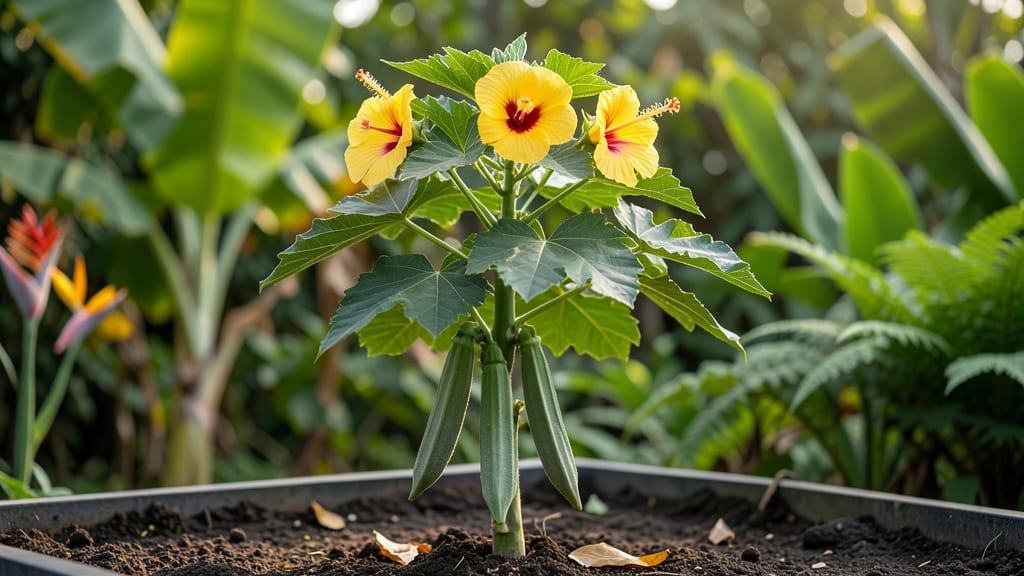
Okra isn't a true perennial—it behaves as an annual in most climates, completing its lifecycle in one growing season, though it may self-seed or regrow from roots in warm regions with proper care. Its growth cycle is heavily influenced by temperature and maintenance.
Okra's classification as a short-lived plant comes from its tropical origins.
Unlike true perennials like asparagus, which regrow from the same root system year after year, okra's growth is triggered by warm temperatures. 🌱 In frost-free zones (8-11), you might see it self-seed or regrow from residual roots, but this isn't true perennial behavior—it's more about favorable conditions than biological hardiness.
The key difference is that okra's "overwintering" is unreliable compared to plants specifically adapted to cold climates.
What this means for gardeners is that while okra may appear perennial in mild winters, it's always safer to treat it as an annual. This approach gives you more control over planting times and harvest windows.
In colder regions, you'll need to replant each spring, while in warm zones, you can extend the season by protecting plants from unexpected cold snaps.
💡 In This Article
- Why Okra Acts Like a Short-Lived Perennial in Warm Climates
- Extending Okra’s Growing Season: Annual vs. Overwintering Strategies
Why okra acts like a short-lived perennial in warm climates
Okra's tropical origins explain why it behaves like a short-lived perennial in mild climates. Native to regions like Ethiopia and the Middle East, okra thrives in 75-85°F temperatures and cannot tolerate frost—its cells rupture below 32°F.
This frost sensitivity means it dies back completely in cold winters, unlike true perennials like asparagus or rhubarb, which have specialized root systems to survive -20°F temperatures. 🌡️
The confusion arises from okra's ability to self-seed aggressively in warm zones (8-11). When pods mature and drop seeds, they germinate quickly in spring, creating dense stands that may look like perennial regrowth.
However, these new plants aren't true regrowth—they're genetically distinct seedlings. The root system itself rarely survives winter, even in mild climates, because okra lacks the cold-hardy cambium layer found in true perennials.
Botanically, okra is classified as an annual or short-day plant, meaning its growth cycle is triggered by daylight length rather than temperature alone. In frost-free areas, this allows it to produce multiple generations in one season, creating the illusion of perennial behavior.
The key difference is that true perennials like lavender or rosemary develop woody stems that persist through winter, while okra remains herbaceous and dies completely when stressed.
What makes okra's behavior particularly interesting is its root system. While not as robust as true perennials, okra develops a fibrous root network that can regenerate new shoots if protected from frost.
In zone 9-11, gardeners often see "overwintered" okra plants, but these are typically new growth from residual roots or fallen seeds—not the same plant persisting from the previous year. 🌱 This is why experienced growers recommend treating okra as an annual even in warm climates.
Consider this comparison: Asparagus sends up new shoots from the same crown each spring, while okra's "regrowth" comes from either self-seeding or new shoots from the base of the stem.
The latter can happen if the plant isn't completely killed back by frost, but this is more about survival than true perennial behavior. True perennials like hostas or daylilies have specialized storage organs (rhizomes, tubers) that maintain metabolic activity through winter.
For gardeners, this botanical difference matters because it affects planting strategies. True perennials establish themselves over years, while okra delivers quick harvests (typically 60-70 days from seed) before needing replacement. This is why many tropical vegetables—like sweet potatoes or eggplants—share similar growth patterns with okra despite being classified differently.