
Flowers
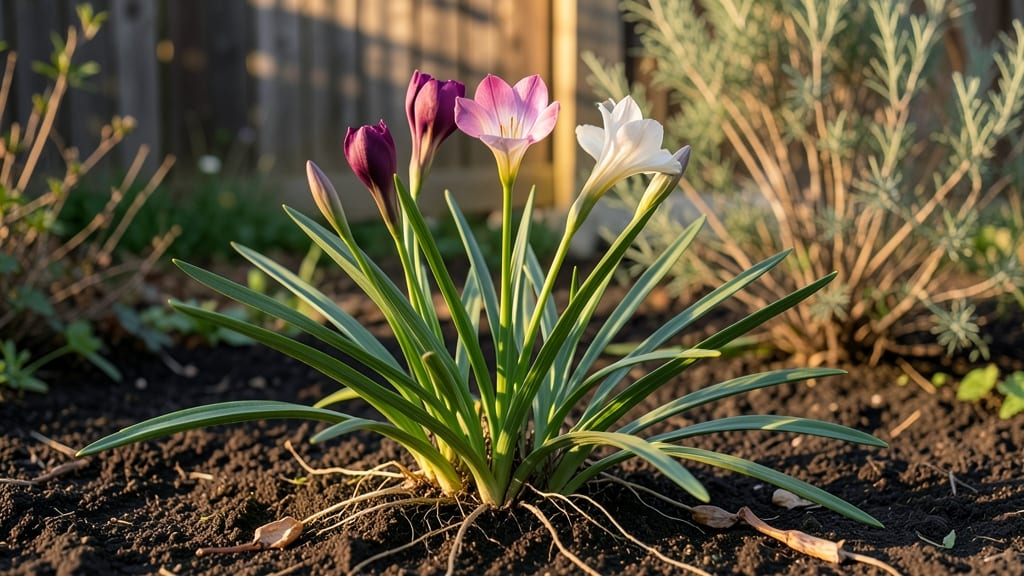
Freesia is not a true perennial in most climates, as its corms die back in cold weather and must be dug up and stored annually. However, in frost-free zones, it can behave like a perennial with proper care and overwintering conditions.
Freesia grows from underground corms—thick, bulb-like roots—that store energy for regrowth.
In warm climates without frost, these corms naturally survive winter and regenerate flowers year after year, mimicking perennial behavior. 🌱 But in colder regions, the corms turn dormant and die if left in the ground, forcing gardeners to dig them up before freezing temperatures.
This seasonal cycle explains why freesia is often treated as an annual despite its potential for long-term growth in ideal conditions.
What makes this tricky is that freesia's lifespan depends entirely on your local climate. In USDA zones 9-11, where winters stay above freezing, freesia can thrive as a self-sustaining perennial.
But in zones 3-8, gardeners must mimic these frost-free conditions by storing corms in dry, cool (50-60°F) environments until replanting in spring. This storage process is what transforms freesia from a short-lived plant into a repeat performer with the right care.
💡 In This Article
- Freesia’s Growth Cycle: Corms, Not True Perennials
- How to Overwinter Freesia Corms for Repeat Blooms
Freesia’s growth cycle: corms, not true perennials
Freesia doesn't produce traditional roots like other perennials—instead, it grows from specialized underground structures called corms. These corms are dense, bulb-like storage organs that contain all the nutrients needed for regrowth.
Unlike true perennials that develop deep root systems to survive winter, freesia corms rely on stored energy to push new shoots when conditions are right. 🌱 The key difference lies in how these corms respond to temperature: when exposed to consistent warmth above 40°F, they remain active and can regenerate flowers year after year.
Here's what happens in colder climates: when temperatures drop below freezing, the corms enter a natural dormancy state. Their metabolic activity slows dramatically to conserve energy, and without protection, they'll eventually rot in the soil.
This is why freesia behaves like an annual in most U.S. growing zones (3-8)—the corms simply can't survive winter exposure. The magic happens in frost-free zones (9-11) where these corms remain viable underground throughout winter, allowing the plant to continue its growth cycle naturally.
The science behind this involves a process called vernalization, where exposure to cold temperatures triggers flowering in some plants—but freesia works in reverse. Its corms need warmth to break dormancy and regrow. In colder regions, gardeners must artificially replicate these frost-free conditions by storing corms in controlled environments.
Without this intervention, the corms would die back completely, making freesia appear as a short-lived plant rather than a perennial.
What's fascinating is how quickly freesia responds to temperature changes. When stored corms are replanted in spring, they can produce flowers in just 8-12 weeks—a remarkably fast growth cycle for a plant that appears to "reset" annually.
This rapid regeneration is one reason why freesia is so popular among gardeners who want perennial-like behavior without the commitment of true hardy perennials. The trade-off is the extra care required during winter months in colder climates.
Consider this comparison: True perennials like peonies develop extensive root systems that can survive -20°F temperatures, while freesia corms begin dying when exposed to just 32°F for extended periods. This fundamental difference in cold tolerance explains why freesia can't be classified as a traditional perennial in most growing conditions.
The plant's entire survival strategy revolves around its corms' ability to store and regenerate energy—making climate control the single most important factor in determining whether freesia will behave as an annual or perennial.