
Plants
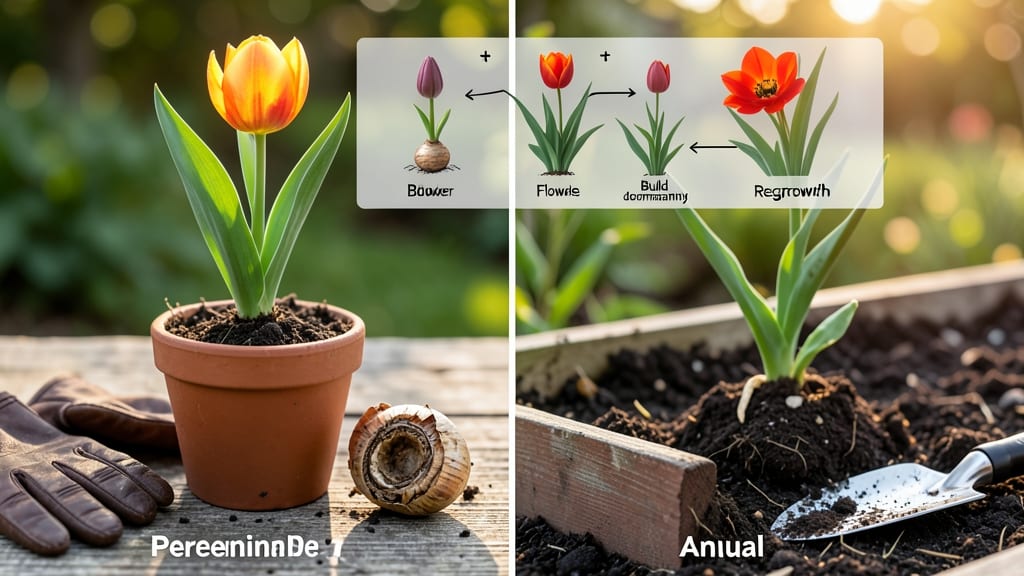
Tulips are perennial plants in their native regions, but most garden varieties are treated as annuals due to their cold sensitivity and tendency to decline after flowering. Proper planting depth and soil conditions can improve their longevity.
Tulips originate as hardy perennials in their natural habitats like Central Asia, where they thrive year after year. 🌱 However, the tulips we commonly grow in gardens often struggle with cold climates and poor soil, causing them to fade after just one blooming season.
The key difference lies in their bulb systems—some varieties store enough energy to regrow, while others exhaust their reserves quickly. For gardeners, this means choosing the right species and providing consistent care can transform these "annuals" into reliable perennials.
Even when treated as annuals, many tulips can return if given the right conditions. 💡 The secret often lies in proper bulb care after flowering—leaving foliage until it yellows ensures the bulb recharges for next year.
Species tulips like Tulipa tarda or Darwin hybrids are particularly resilient, often lasting 5+ years with minimal effort. The misconception stems from how most gardeners plant and maintain them, not their inherent botanical nature.
💡 In This Article
- Why Most Tulips Act Like Annuals Despite Being Perennials
- How to Extend Tulip Lifespan in Gardens
Why most tulips act like annuals despite being perennials
Tulips belong to the Liliaceae family and are botanically classified as geophytes, meaning they store energy underground in bulbs. These bulbs contain specialized cells that allow tulips to survive harsh winters and regrow each spring—a classic perennial trait.
However, most garden tulips behave like annuals because they originate from temperate climates where winters are cold but not extreme. When planted in regions with freezing temperatures below -20°F (-29°C), their delicate bulb systems often fail to regenerate properly.
The key difference lies in their cold-hardiness zones. Species tulips like Tulipa tarda (native to Siberia) thrive in Zone 3 (-40°F/-40°C), while popular hybrid tulips (like Parrot or Fringed varieties) struggle below Zone 5 (15°F/-9°C).
The bulb's root system must remain undisturbed and well-insulated with organic matter to survive winter. Without this protection, the bulb depletes its energy reserves during flowering, leaving nothing for regrowth.
Another critical factor is the dormancy cycle. Tulips enter dormancy after blooming, but they require 6-8 weeks of foliage growth to replenish nutrients. Most gardeners mistakenly cut back foliage too soon, starving the bulb.
This process is why species tulips—with their deeper root systems—often outlast hybrids. For example, Darwin Hybrid tulips can live 5-10 years with proper care, while double-flowered varieties may only return for 2-3 seasons.
Soil conditions play a surprising role too. Tulips prefer well-draining, slightly acidic soil (pH 6.0-7.0), but heavy clay or waterlogged soil causes bulbs to rot. In their native steppes, tulips grow in light, sandy loam with minimal organic matter—a stark contrast to nutrient-rich garden soils.
This mismatch often leads to bulb exhaustion, reinforcing their annual-like behavior. 🌱
What most gardeners don't realize is that tulips' flowering intensity directly impacts their longevity. Each bloom consumes 30-50% of the bulb's energy reserves. Double-flowered varieties, prized for their dramatic blooms, deplete reserves faster than single-stemmed types.
This is why species tulips, which produce fewer but hardier flowers, often outperform hybrids in perennial performance.
Even in ideal conditions, tulips face pest pressure from squirrels, voles, and fungal diseases like tulip fire (caused by Botrytis tulipae), which can weaken bulbs over time. These factors combine to create the illusion of annual behavior, masking their true perennial nature when given the right care.
The solution lies in selecting cold-hardy varieties and mimicking their native growing conditions.