
Plants
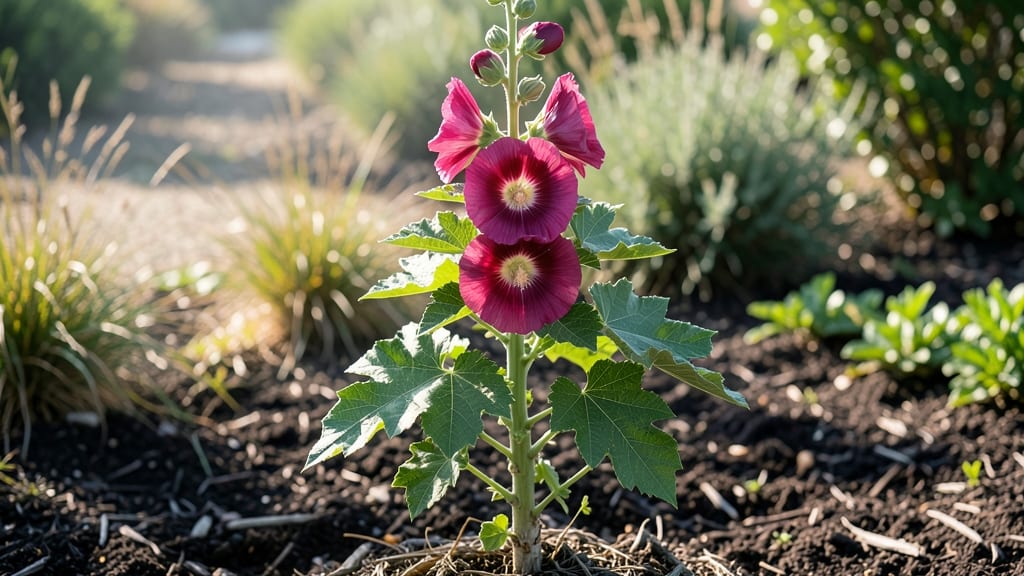
Hollyhocks are perennials that die back to the ground each winter but regrow from their roots, though some varieties may self-seed prolifically. Their hardiness varies by climate, with most thriving in USDA zones 3-9.
Hollyhocks prove their perennial nature through their underground root systems, which store energy during dormancy and fuel spring regrowth. 🌱 Unlike annuals that complete their life cycle in one season, hollyhocks rely on these resilient roots to push through soil each spring, often returning even stronger.
Their ability to self-seed adds another layer of persistence—some gardeners consider this a blessing (for free blooms) and others a challenge (for controlling spread). The key to their survival lies in their adaptability to cold climates, making them ideal for northern gardens where many tender perennials struggle.
What sets hollyhocks apart is their two-phase growth pattern: they produce foliage first, then flower stalks later in the season. This delayed blooming gives them time to establish strong root systems before winter, ensuring they can handle freezing temperatures.
In milder climates (zones 8-9), some varieties may even bloom year-round with proper care, though they'll still exhibit some seasonal dieback. The trade-off? Their dramatic winter dormancy makes them perfect for cottage gardens where seasonal changes create natural interest.
💡 In This Article
- Why Hollyhocks Die Back and Regrow as Perennials
- Caring for Hollyhocks to Ensure Year-Round Survival
Why hollyhocks die back and regrow as perennials
The hollyhock's survival strategy begins with its taproot system, a thick, carrot-like root that extends deep into the soil.
Unlike annuals that rely on quick top growth, hollyhocks invest energy underground during their first growing season, building reserves of starches and sugars that can sustain them through 3-6 months of dormancy.
When temperatures drop below 32°F, the plant's cells produce antifreeze proteins that prevent ice crystals from forming in their tissues, a process similar to how woody shrubs like lilacs survive winter.
This dormancy isn't just passive waiting—it's an active metabolic slowdown where the plant redirects energy to protect its meristem cells (growth centers). In late winter, when soil temperatures reach 40-45°F, these meristems detect moisture and warmth, triggering the release of growth hormones like gibberellins.
The roots then push upward through the soil, often emerging 4-6 weeks before the foliage appears above ground—a phenomenon gardeners call "pushing through." 🌱 What makes this remarkable is that some hollyhock varieties can remain dormant for up to 9 months in harsh climates (like zone 4), yet still regrow with minimal energy loss.
The comparison to annuals and biennials highlights hollyhocks' unique advantage. Annuals like sunflowers complete their entire life cycle in one season, while biennials like foxgloves store energy for two years before flowering.
Hollyhocks, however, combine the best of both: they establish strong roots like perennials but can produce seed pods in their first year if conditions are right, giving them flexibility in unpredictable climates.
Their self-seeding habit stems from this dual strategy—when they sense shortening daylight in fall, some varieties will bolt (flower and set seed) while others focus on root development, creating a built-in insurance policy.
Cold temperatures actually enhance hollyhock survival by breaking seed dormancy and stimulating root growth. Studies show that hollyhock seeds require 60-90 days of cold stratification (40°F or below) to germinate reliably—a process that happens naturally in most northern gardens.
This cold requirement explains why hollyhocks thrive in zones 3-9 but struggle in tropical climates (zones 10-11), where they may become more annual-like due to lack of proper winter chilling.
The plant's ability to "count" cold days is controlled by a gene called VERNALIZATION1, which acts as a biological timer for growth cycles.
What most gardeners overlook is how hollyhocks' foliar structure contributes to their resilience. Their large, fuzzy leaves contain trichomes (hair-like structures) that reflect sunlight and reduce water loss during drought, while their hollow stems act as insulation against temperature swings.
When you see hollyhocks reblooming in late summer, you're witnessing a second flush of growth fueled by the same roots that survived winter—proof of their true perennial nature. This dual-flowering ability is rare among perennials and makes hollyhocks one of the most adaptable garden plants for seasonal interest.
Consider this: a well-established hollyhock plant can produce 50-100 seeds per stalk, yet still regrow from its roots the following spring.
This balance between seed production and vegetative growth is what classifies hollyhocks as facultative perennials—they can behave as annuals if conditions aren't right, but will always revert to perennial behavior when given proper winter dormancy. The key takeaway?
Their dieback isn't a sign of weakness—it's a sophisticated survival mechanism honed over centuries of evolution in temperate climates. 💫