
Plants
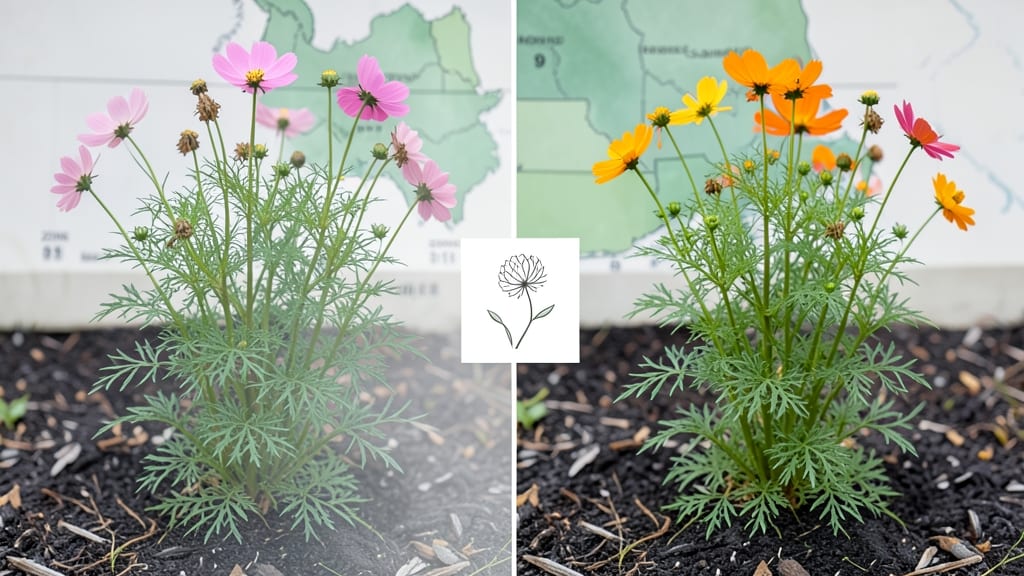
Cosmos plants aren't true perennials in most regions, but they reliably return each year as self-seeding annuals or short-lived perennials in USDA zones 9-11, where mild winters let them bloom continuously without replanting.
This self-sowing behavior is what makes cosmos so beloved by gardeners—they'll pop up year after year even if you don't replant them. 🌸 In warmer climates, their roots persist through winter, while in colder zones, the seeds simply wait for spring to germinate naturally.
I've seen cosmos gardens where the plants grow thicker every year because the seeds spread and establish new plants organically.
The key difference lies in their hardiness: while they won't survive freezing temperatures as true perennials, their lightweight seed heads disperse easily, creating a natural renewal cycle. This makes them perfect for low-maintenance gardens where you want reliable color without annual replanting.
💡 In This Article
- How Cosmos Plants Survive Winter in Mild Climates
- Extending Cosmos Blooms Year-Round in Cooler Regions
How cosmos plants survive winter in mild climates
Cosmos plants exhibit a fascinating survival strategy in warm climates, where they behave like short-lived perennials. In USDA zones 9-11, their fibrous root systems—typically 12-18 inches deep—persist through mild winters, though they may become dormant.
The key lies in their ability to photosynthesize even at 50-60°F, allowing them to maintain energy reserves. Unlike true perennials, cosmos don't regrow from the same rootstock every year, but their roots stay alive long enough to produce new growth when temperatures rise.
Their seed viability plays a crucial role too. Cosmos produce thousands of tiny, lightweight seeds that remain dormant but viable for 2-5 years in the soil. In warm zones, these seeds often germinate naturally in early spring, creating dense clusters of plants.
The plant's ability to both persist through roots and self-seed means gardeners rarely need to replant—once established, cosmos create their own renewal cycle. 🌱 This dual survival mechanism explains why they thrive in Mediterranean climates where winters rarely drop below 30°F.
In colder regions, however, this strategy fails because cosmos roots can't withstand prolonged freezing. Below 20°F, the root systems die back completely, leaving only the seeds to carry the species forward.
This is why cosmos are classified as annuals in most climates—they complete their entire life cycle in one growing season, relying entirely on seed dispersal for renewal. The botanical term for this is "winter annual" behavior, where plants germinate in fall, grow through winter, and flower in spring.
What makes cosmos unique is their adaptability. While they won't survive as true perennials in cold climates, their lightweight seed heads (which resemble dandelions) disperse easily with even the slightest breeze. This natural propagation means they'll return year after year—just not from the same plants.
In warm zones, this creates a perpetual cycle where cosmos appear to "come back" annually, even though they're technically not perennial in the traditional sense.
Gardeners often notice this behavior when cosmos plants seem to multiply magically each year. The secret lies in their 1-2 inch seed heads that contain hundreds of seeds, each capable of producing a new plant.
In ideal conditions, a single cosmos plant can generate 500-1,000 seeds, ensuring constant renewal. This self-sowing characteristic is what gives cosmos their reputation as "perennial-like" plants in warm climates.
Their success in mild winters also comes from their drought tolerance. Cosmos can survive with minimal water once established, and their deep roots help them access moisture during dry spells.
This combination of seed viability, root persistence, and drought resistance explains why they thrive in Mediterranean climates where other annuals might struggle to return year after year. 🌿