
Orchid Care
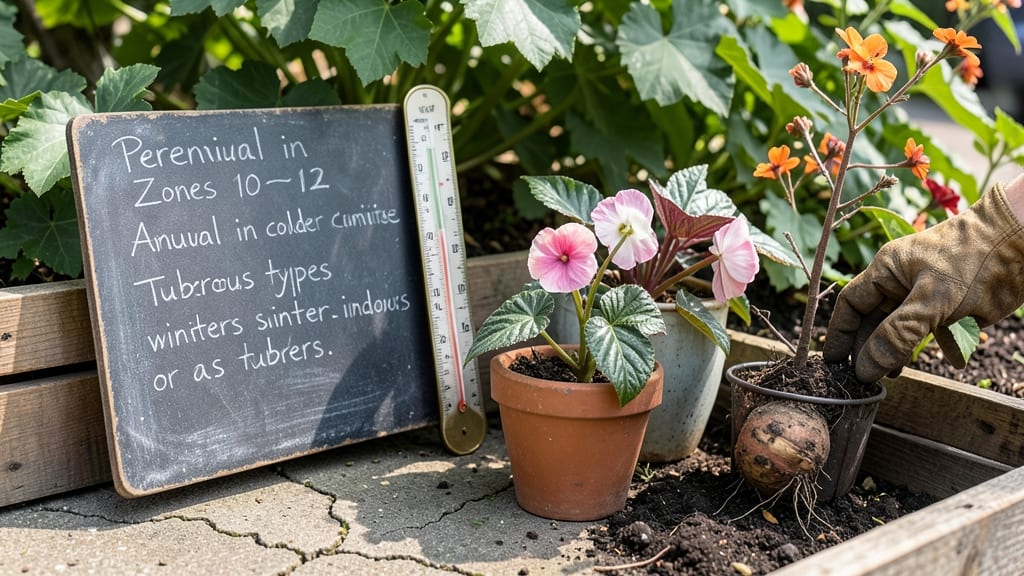
Begonias are perennials in warm climates but often treated as annuals in cold regions, as frost kills their tender tubers and foliage, requiring replanting each spring if temperatures drop below 40°F.
Whether begonias act as annuals or perennials depends entirely on your climate. 🌱 These tropical plants thrive year-round in USDA zones 10-12, where they naturally regrow from their underground tubers each season.
However, in colder zones (like 3-9), the first frost triggers irreversible damage to their delicate storage organs, forcing gardeners to replant from cuttings or store tubers indoors until spring. The key difference lies in their biological response to temperature shifts—what's dormancy in warm zones becomes death in cold ones.
Understanding this behavior helps explain why nurseries often sell begonias as annuals: they're designed for one-season growth in northern climates. But with proper overwintering techniques—like digging tubers before frost or using grow lights indoors—you can transform them into multi-year perennials even in freezing regions.
The 40°F threshold isn't arbitrary; it's when cell membranes rupture in their storage organs, making revival impossible.
💡 In This Article
- Why Begonias Die in Cold Weather
- How to Overwinter Begonias in Cold Climates
Why begonias die in cold weather
Begonias originate from tropical and subtropical regions, where temperatures rarely drop below 60°F year-round. Their biological systems—particularly their storage organs—evolved without ever experiencing frost. The most common types, like tuberous begonias, develop thickened underground tubers that store nutrients for regrowth.
When temperatures plummet below 40°F, these tubers undergo cellular damage because their membranes lack the protective proteins found in cold-hardy plants (like antifreeze proteins in woody perennials).
The damage happens in two stages: first, water inside tuber cells begins to freeze, forming sharp ice crystals that pierce cell walls. Second, the 40°F threshold triggers a cascade where enzymes meant for growth become inactive, and the tuber's protective skin cracks.
This is why you'll often see begonias that look healthy one day and completely blackened the next after a light frost—what appears to be dormancy is actually irreversible cell death. 🌡️
Interestingly, not all begonias have the same cold tolerance. Fibrous-rooted begonias (like Begonia rex) are even more sensitive because they lack the protective tuber structure entirely. Their roots freeze solid at 35°F, while tuberous types might survive brief exposures to 38°F if they're dormant.
This explains why nurseries often recommend treating all begonias as annuals in zones colder than 9—the risk of survival drops below 50% even with careful overwintering.
What makes this particularly frustrating for gardeners is how begonias mimic dormancy before dying. In the weeks leading up to frost, they'll slow growth, drop leaves, and even appear to enter a resting state—just like perennials in warm climates.
However, unlike true perennials, begonias don't produce protective compounds (like proline amino acids) that shield their cells from cold damage. The confusion arises because their early dormancy-like behavior gives false hope that they might recover, when in reality, their biological makeup is fundamentally incompatible with freezing temperatures.
Consider this comparison: A daylily (a true perennial) can survive -20°F because its rhizomes produce antifreeze proteins and store carbohydrates to repair frost damage. A begonia tuber, meanwhile, has none of these adaptations—its survival depends entirely on staying above 40°F.
This fundamental difference explains why begonias thrive as perennials in Florida but must be replanted annually in Minnesota. 🌱