
Plants
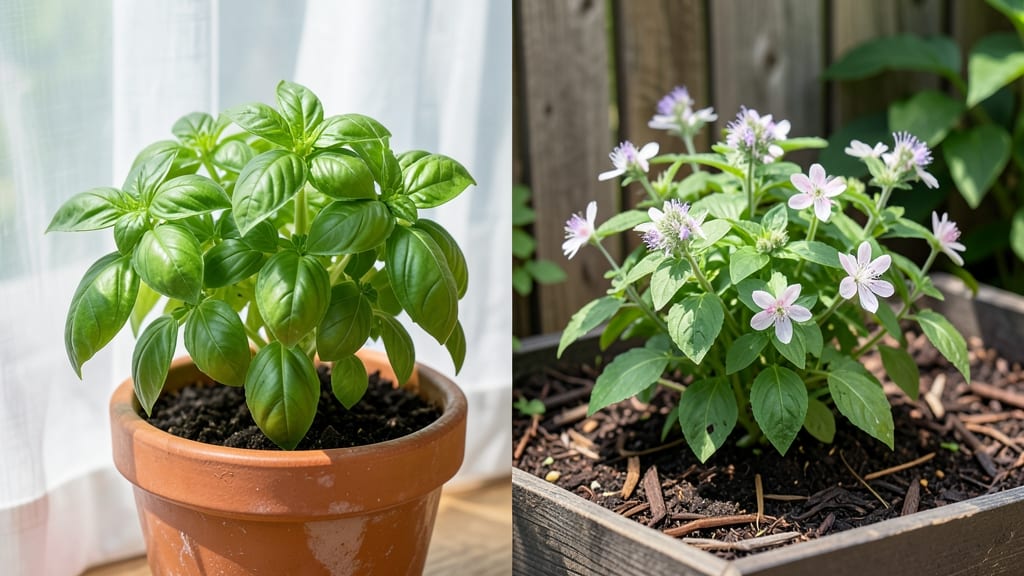
Basil plants are not perennial in most climates, especially cold regions, as they die when temperatures drop below 40°F (4°C). However, they can be overwintered indoors or regrown from seeds each spring in warmer zones like USDA 10-11.
Basil's tropical origins mean it's not built to survive freezing temperatures, which is why gardeners in colder zones treat it as an annual. 🌱 The moment frost hits, the plant's cells rupture, and it won't recover—even if the ground stays unfrozen.
That said, I've successfully brought basil through winter by harvesting healthy stems before the first cold snap and moving them to a sunny windowsill. The key is maintaining consistent moisture and providing grow lights since natural daylight drops in winter months.
If you're in a milder climate like USDA 10-11, you might get lucky with basil persisting through winter, but don't count on it. Even there, the plant often becomes woody and less productive.
For most of us, the real magic happens when we start fresh seeds each spring—nothing beats that first flush of tender new leaves after winter's end.
💡 In This Article
- Why Basil Dies in Cold Weather: Plant Biology Explained
- How to Overwinter Basil Plants in Cold Climates
Why basil dies in cold weather: plant biology explained
Basil's tropical heritage explains why it can't survive freezing temperatures. Native to warm regions like Central Africa and Southeast Asia, basil thrives in 75-85°F conditions and wilts when exposed to below 50°F for extended periods.
The plant's cells contain high moisture levels (about 90% water content), which freeze and rupture at 32°F—the same mechanism that kills tender lettuce or tomato plants in frost. 🌡️ Unlike hardy perennials such as mint or oregano, basil lacks the protective mechanisms to enter true dormancy or produce insulating tissues like woody stems.
The damage happens at a cellular level: ice crystals form in the plant's vascular system, disrupting water transport and causing irreversible damage to cell membranes. This is why even a light frost (30-32°F) can kill basil plants overnight.
For comparison, cilantro—a similarly tender herb—survives slightly better due to its slightly lower water content (85%), but both share the same tropical ancestry that makes them frost-sensitive. The key difference is that cilantro often bolts (goes to seed) rather than dying completely, while basil simply shrivels without recovery.
What most gardeners don't realize is that basil's sensitivity extends beyond just freezing temperatures. Even cool 50-55°F nights trigger stress responses in the plant, causing it to produce fewer leaves and more bitter compounds.
This is why basil grown in spring or fall often tastes harsher than summer plants—it's essentially conserving energy for survival rather than growth.
The plant's natural response to cold is to allocate resources toward seed production (bolting), but since basil is typically harvested before flowering, this adaptation becomes moot in colder climates.
Here's what happens during a freeze: within 1-2 hours of temperatures dropping below 32°F, basil leaves turn black as cellular structures collapse. The stems become mushy, and the roots lose their ability to absorb water.
Even if the pot stays above freezing (as in container gardening), the plant's exposed foliage will still suffer damage. This is why gardeners in zones USDA 7 and colder treat basil as an annual—it simply can't withstand winter's chill without human intervention.
Interestingly, basil's close relatives like holy basil (Ocimum tenuiflorum) have slightly better cold tolerance, surviving down to 40°F with proper protection. However, even these varieties struggle in prolonged cold snaps.
The key takeaway is that basil's biology is fundamentally incompatible with temperate winters, which is why overwintering requires creating artificial tropical conditions indoors. 🌿
For those curious about the science, basil's frost sensitivity stems from its C3 photosynthetic pathway, which is less efficient in cooler temperatures compared to C4 plants like corn. This makes it more vulnerable to temperature fluctuations.
The good news? This same sensitivity is what gives basil its rapid growth and intense flavor when conditions are ideal—just not when winter rolls around.