
Flowers
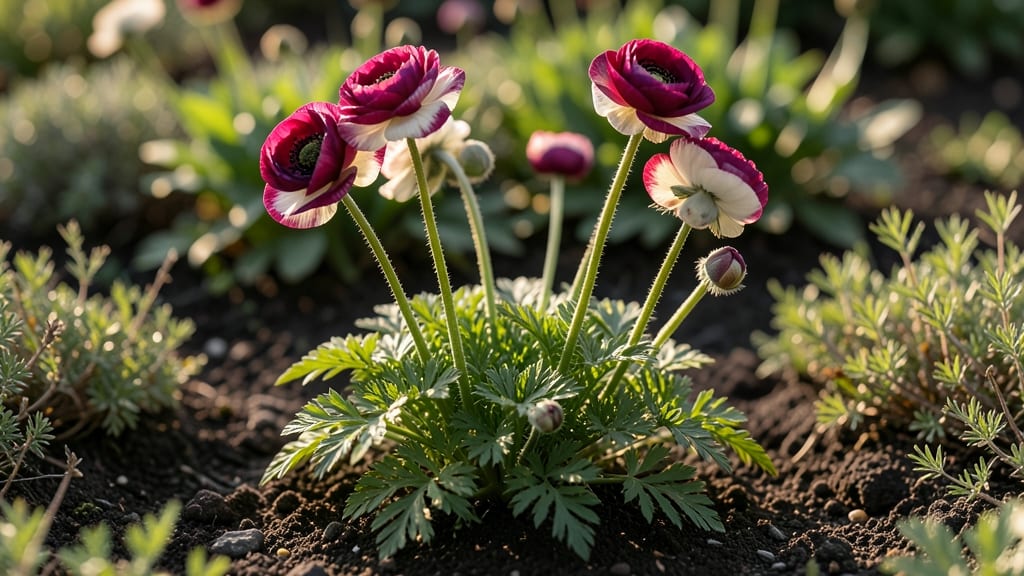
Deciding whether ranunculus flowers are perennial or annual depends on your climate: they grow as annuals in most regions but can act as short-lived perennials in mild, frost-free winters. Cold-hardy types may survive zones 8-10 with protection, though they rarely last beyond one season without special care. Their ability to rebloom hinges on consistent deadheading and seasonal conditions.
Ranunculus actually stores energy in underground tubers, which explains why they "reset" each growing season in colder climates. 🌱 Without proper winter protection, these tubers often fail to regenerate, forcing gardeners to replant annually.
In warmer zones, however, they can return year after year with minimal effort—though even there, their lifespan rarely exceeds 3-4 seasons without intervention.
What truly sets ranunculus apart is their dramatic seasonal transformation. When grown as annuals, they deliver a spectacular spring show, but their tuber-based growth habit means they can't compete with true perennials like peonies.
The key to extending their garden life lies in protecting those tubers—whether through mulching, lifting, or selecting cold-resistant varieties.
💡 In This Article
- Why Ranunculus Dies Back in Cold Climates
- Extending Ranunculus Bloom Life with Perennial Care
Why ranunculus dies back in cold climates
Ranunculus relies on specialized underground tubers to store nutrients, unlike true perennials that develop deep root systems or crowns. These tubers contain all the energy needed for regrowth, but they're highly sensitive to freezing temperatures below 20°F.
When exposed to prolonged cold, the tuber cells rupture, killing the plant's ability to regenerate—this is why most gardeners treat them as annuals in zones 3-7.
The tuber's shallow depth (typically 3-5 inches below soil) makes it vulnerable to freeze-thaw cycles. Compare this to peonies, whose thick, woody crowns sit 6-8 inches deep and survive -20°F without issue.
Ranunculus tubers also lack the protective bark-like layers found in perennials like daffodils, which can endure -10°F with proper mulching.
What's fascinating is how ranunculus adapts in warmer climates. In zones 8-10, tubers naturally enter dormancy when temperatures drop to 40-50°F, then regrow when soil warms to 55°F. This explains why they sometimes return as short-lived perennials—though even there, their lifespan rarely exceeds 3 years without human intervention.
Another key factor is the plant's growth cycle. Ranunculus completes its entire life cycle in 90-120 days, producing flowers, setting seed, and then dying back—similar to how annuals operate. This rapid turnover explains why gardeners often replant them yearly, even in mild climates where tubers might technically survive.
The science behind this involves a process called "cold acclimation." True perennials gradually harden their tissues as temperatures drop, but ranunculus tubers lack this adaptation. Their cells contain high moisture levels that freeze and expand, causing irreversible damage—a phenomenon called "cryoinjury" in botanical terms.
Consider this: While a peony might regrow from the same crown for 50+ years, ranunculus tubers typically degrade after 2-3 seasons even with ideal conditions. This biological limitation is why they're classified as "short-lived perennials" rather than true perennials in most gardening contexts.