
Planting
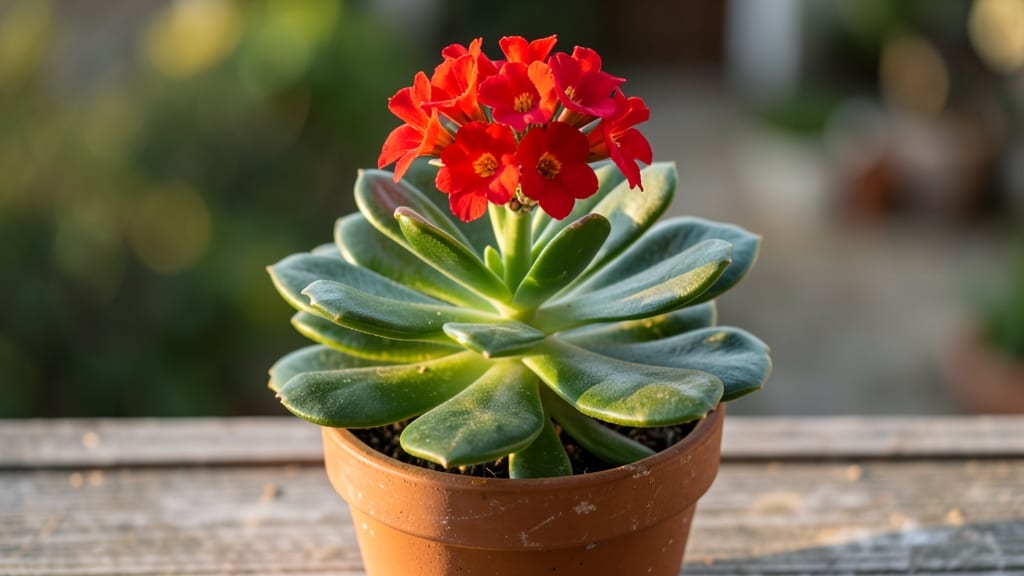
The kalanchoe plant functions as a perennial in frost-free regions, continuing to grow with consistent care, but acts like an annual in colder zones where freezing temperatures kill it. Its drought-resistant structure enables it to enter dormancy during harsh conditions and rebound when favorable weather returns.
The kalanchoe's perennial status depends entirely on climate.
In USDA zones 10-12, these plants thrive outdoors year-round, their thick leaves storing moisture to survive dry spells. 🌵 However, when temperatures drop below 32°F, the plant's cells rupture, making it unable to recover—this is why gardeners in colder areas treat kalanchoe as seasonal rather than permanent.
The key to extending its life is mimicking its natural dormancy cycle: reduce watering in winter and provide bright, indirect light to keep it alive until spring.
What sets kalanchoe apart is its ability to "reset" after dormancy. Unlike true annuals, which complete their lifecycle in one season, kalanchoe can regrow from the base if given proper conditions.
This makes it a semi-perennial in marginal climates—technically not a true perennial, but far more resilient than most people realize.
💡 In This Article
- Kalanchoe Perennial Traits: Dormancy and Cold Resistance
- Growing Kalanchoe as a Perennial: Climate and Care Tips
Kalanchoe perennial traits: dormancy and cold resistance
The kalanchoe's perennial nature stems from its succulent biology, where thick, water-storing leaves act as natural batteries. These leaves contain specialized cells called parenchyma, which expand to hold moisture during dry periods—some varieties store up to 90% water by weight.
This adaptation allows the plant to survive months without rainfall, a trait shared with cacti but far more flexible in terms of temperature tolerance.
When conditions turn unfavorable—either through drought or cold—the kalanchoe triggers dormancy by slowing metabolic processes. Unlike true annuals, which die after flowering, kalanchoe can pause growth and revive when conditions improve. The breaking point comes at 32°F, where ice crystals form in the plant's cells, rupturing their structure.
This is why kalanchoe thrives in USDA zones 10-12 but struggles in colder regions.
What makes kalanchoe unique is its photoperiodic response. Many succulents enter dormancy based on daylight hours, but kalanchoe also responds to temperature shifts. In winter, its growth slows dramatically, but the roots and basal stems often remain viable.
This explains why gardeners can propagate kalanchoe from cuttings even after the main plant appears dead—it's not truly gone, just dormant.
Comparing kalanchoe to true perennials like lavender reveals key differences. While lavender has woody stems that survive winter, kalanchoe relies entirely on its fleshy leaves and roots.
This makes it more vulnerable to freeze damage but also more adaptable to container growing, where you can move it indoors before temperatures drop below 50°F.
Another fascinating mechanism is the plant's ability to regenerate from leaf cuttings. Even a single healthy leaf can develop roots and grow into a new plant—a survival strategy that ensures the species persists even when the main plant dies.
This resilience explains why kalanchoe often outlives its reputation as a "temporary" houseplant.
The confusion about kalanchoe's perennial status often stems from how gardeners treat it. In frost-free climates, it grows continuously, but in colder areas, people plant it as an annual because they don't protect it through winter.
With proper care—like bringing it indoors or providing insulation—kalanchoe can live for 5-10 years or more, making it a true long-term addition to gardens.