
Flowers
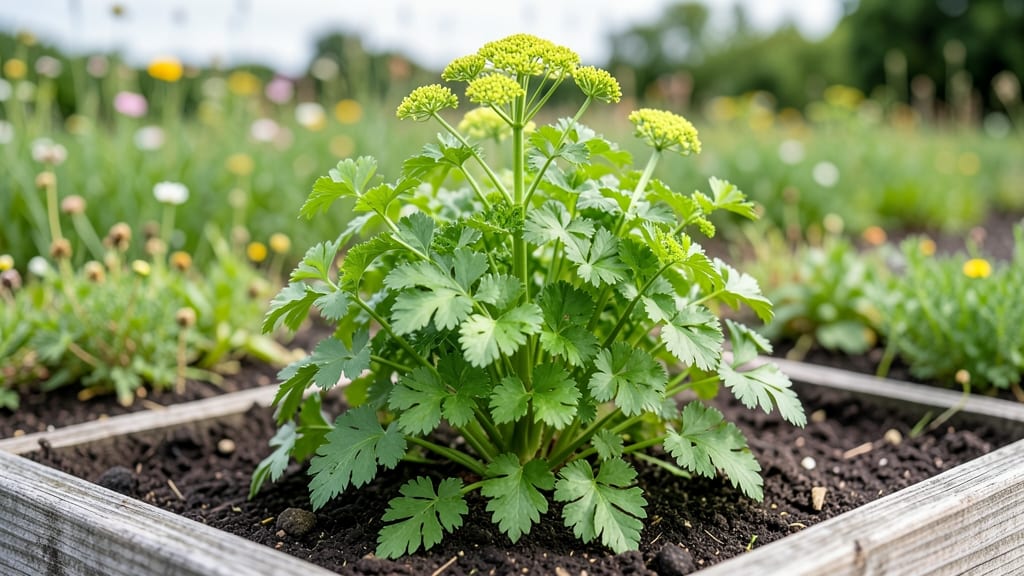
Parsley isn't a true perennial—it's a biennial that mimics perennial behavior by regrowing from its root crown for 2-3 years in mild climates before eventually dying back permanently.
This classification matters because parsley's life cycle follows a two-year pattern: it produces leaves in its first year, flowers and seeds in its second, then declines. 🌱 In frost-free zones, the root crown often survives winter and pushes new growth, creating the illusion of perennial behavior.
However, even in ideal conditions, parsley eventually exhausts its energy reserves and stops producing reliably after 3 years.
Understanding this cycle helps gardeners plan better. For instance, you can harvest parsley leaves aggressively in its first year to encourage bushier growth, knowing it'll still have energy reserves for next season.
The key is maintaining healthy soil—rich in organic matter—and protecting the roots from extreme cold or drought, which can accelerate its decline.
💡 In This Article
- Parsley’s Biennial Life Cycle Explained
- How to Extend Parsley’s Productivity in Gardens
Parsley’s biennial life cycle explained
The confusion around parsley's classification stems from its two-stage life cycle. In its first year, parsley focuses entirely on leaf production—developing a robust root system and lush foliage that gardeners harvest.
This stage is what makes it feel like a perennial, as the plant can continue growing for 12-18 months under ideal conditions.
The secret lies in its taproot system, which stores energy in the root crown (the thickened base where roots meet stems), allowing it to survive winter in mild climates.
Here's where the biennial nature reveals itself: during its second year, parsley shifts priorities entirely. Instead of producing leaves, it devotes energy to flowering and seed production. You'll notice tall, 1-3 foot stems with delicate yellow or white flowers appearing in spring.
This flowering phase is critical—it's the plant's way of ensuring reproduction before its energy reserves deplete. The trade-off?
Leaf production drops dramatically as the plant redirects nutrients to seed development. 🌸 What most gardeners miss is that this shift happens even in frost-free zones, though the timeline may stretch to 2-3 years before full decline.
The root crown's ability to regenerate is what creates the perennial illusion. In zones without hard freezes (USDA zones 8-10), parsley can push new growth from the same root system for multiple seasons. However, this isn't true perennial behavior—it's more like a short-term survival strategy.
The root crown contains meristematic cells (growth cells) that remain dormant until conditions are favorable. Each regrowth cycle draws from these limited reserves, which explains why parsley eventually peters out after 3 years even in perfect conditions.
Temperature plays a crucial role in this cycle. Parsley is a cool-season crop that thrives at 60-70°F during active growth. When nights drop below 50°F consistently, the plant senses winter's approach and shifts into survival mode.
In colder climates (zones 5-7), the root crown often dies back completely, requiring replanting each year. The contrast is striking: in Florida, I've seen parsley regrow from the same root for 4 years, while in New England, it typically lasts just 1 season without protection.
What's fascinating is how parsley's life cycle mirrors other biennials like carrots or onions. The key difference is parsley's ability to produce edible foliage in both years (though diminished in year two), while most biennials become inedible during their reproductive phase.
This makes parsley uniquely valuable in kitchen gardens—you get two harvests from one planting before the plant finally exhausts its energy reserves. The lesson? Treat parsley like a short-term perennial: plan for eventual replacement while maximizing its productive years.
For visual learners, imagine parsley's life as three distinct chapters: Year 1 (leaf production), Year 2 (flowering/seeding), and Year 3+ (gradual decline). Each chapter has different care requirements—Year 1 needs aggressive harvesting to encourage bushiness, while Year 2 benefits from reduced leaf cutting to preserve energy for seeds.
This understanding transforms parsley from a finicky herb into a predictable, manageable garden star. 🌱