
Flowers
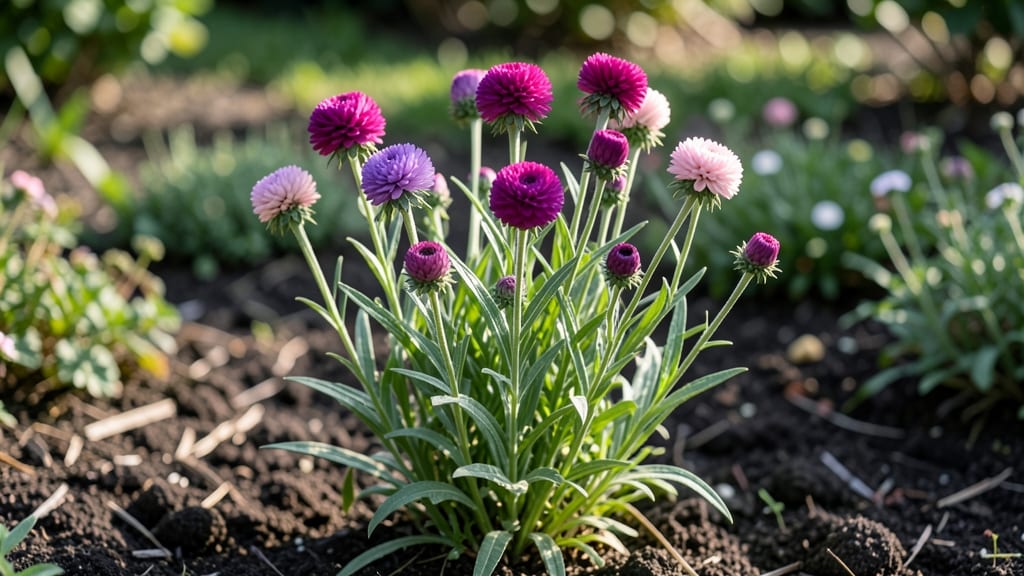
Gomphrena is not a perennial in most climates but behaves as an annual or short-lived perennial, dying back in cold winters unless grown in USDA zones 10-11 where frost-free conditions allow it to regrow from its fibrous root system.
Gomphrena's lifespan depends entirely on where you live. 🌱 In colder regions, it thrives for one season but won't survive winter—its roots simply can't withstand frost. However, in frost-free zones like Southern California or Florida, the same plant can regrow year after year from its deep, fibrous roots.
This makes it behave like a short-lived perennial in ideal conditions, while most gardeners treat it as an annual.
The key difference lies in temperature tolerance. Gomphrena's roots store energy but need consistent warmth to regenerate. In zones 10-11, you'll often see it return stronger each year, while gardeners in colder areas must replant fresh seeds annually.
The plant's adaptability is what makes it so popular—just don't expect it to outlast winter unless you're in its native subtropical range.
💡 In This Article
- Gomphrena’s Root System and Cold Tolerance
- How to Extend Gomphrena’s Lifespan in Cooler Climates
Gomphrena’s root system and cold tolerance
Gomphrena’s survival hinges on its fibrous root system, which stores energy but lacks the hardiness of true perennials like lavender or hosta. These roots spread horizontally just below the soil surface, forming a dense network that absorbs moisture and nutrients efficiently.
However, they’re not insulated against frost—when temperatures drop below 28°F, the cellular structure of these roots begins to break down, a process called cryodamage, where ice crystals form inside plant tissues and rupture cell walls. 🌡️
The plant’s cold tolerance varies dramatically by variety, but even the hardiest types struggle in zones colder than 9b. In frost-free zones (10-11), gomphrena’s roots remain active year-round, slowly replenishing their energy reserves through photosynthesis.
This allows the plant to regrow from the same root system each spring, effectively behaving as a short-lived perennial. The difference? True perennials like salvia have deeper, more insulated root crowns that survive -10°F or colder.
What’s fascinating is how gomphrena’s growth habit changes with temperature. In warm climates, it grows 2-3 feet tall with dense foliage, while in cooler zones, it often stays shorter (1-2 feet) and produces fewer flowers.
This stunted growth is the plant’s survival mechanism—conserving energy to protect its roots. The fibrous structure also makes it prone to drying out, which is why consistent moisture is critical in its native subtropical habitats.
Scientifically, gomphrena’s lifespan classification falls under hemicryptophytes—plants that survive winter with buds at or just below the soil surface. Unlike geophytes (like tulips), which store energy in underground bulbs, gomphrena relies on its fibrous roots.
This makes it vulnerable to both frost and drought, explaining why it’s treated as an annual in most gardens. 🌱
Consider this comparison: In USDA Zone 10, a gomphrena plant might live 3-5 years with proper care, while in Zone 6, it’s lucky to make it through a single summer. The transition point is often 32°F—below this, even the hardiest varieties will die back completely.
This threshold explains why gardeners in Florida can propagate gomphrena from cuttings year-round, while those in New England must start fresh each spring.