
Flowers
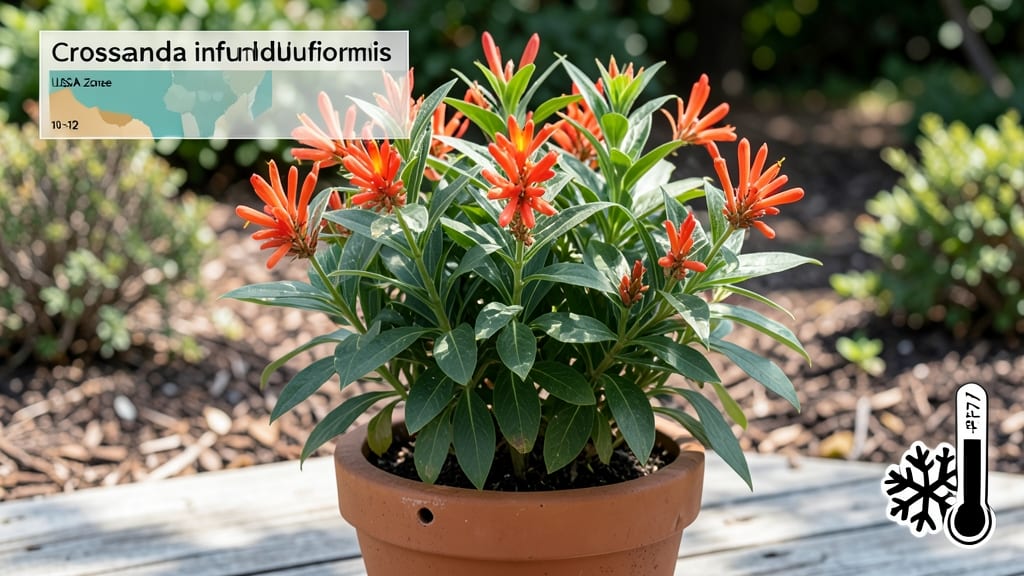
Crossandra isn't a true perennial in most regions, since it only survives year-round in USDA zones 10-12 and will die back when frost hits. That said, gardeners in warmer areas can keep it alive through winters by bringing it indoors or treating it as a long-lived annual.
This tropical plant's sensitivity to cold stems from its origins in India and Southeast Asia, where temperatures rarely drop below 50°F. 🌿 Unlike true perennials that enter dormancy, Crossandra's stems and leaves blacken and die when exposed to frost, though the roots may survive briefly.
The good news is that even in colder climates, you can propagate new plants from cuttings each spring to maintain your garden's vibrant orange blooms.
For those in marginal zones 9-10, the key is acting fast when temperatures dip. I've found that potting up plants before the first frost and moving them to a sunny indoor spot prevents complete die-off.
Just be prepared to trim back any frost-damaged growth in spring—new shoots will emerge quickly from the base. Some nurseries now offer slightly hardier varieties bred for zone 9, though they still won't tolerate hard freezes.
💡 In This Article
- Crossandra’s Cold Sensitivity and Growth Cycle
- How to Extend Crossandra’s Lifespan in Cooler Climates
Crossandra’s cold sensitivity and growth cycle
Crossandra's tropical origins in India and Southeast Asia explain its cold intolerance. This firecracker flower evolved in regions where temperatures rarely drop below 50°F, making it unable to survive frost like true perennials that enter dormancy.
When exposed to 32°F or lower, its cell membranes rupture due to ice crystal formation, causing the stems and leaves to blacken within hours. Unlike hardy perennials that regrow from protected root systems, Crossandra's entire above-ground structure typically dies back completely.
The plant's growth cycle differs fundamentally from true perennials. While most perennials like hostas or daylilies develop underground rhizomes or bulbs that survive winter, Crossandra relies on tender, herbaceous stems that lack cold-hardiness.
Its roots may persist briefly in mild winters, but the plant cannot regenerate from them without warm conditions. This is why gardeners in zones 10-12 can treat it as a perennial—it continues growing year-round without dormancy, but in colder areas, it behaves more like a short-lived annual.
What makes Crossandra unique is its rapid regrowth pattern. Even after complete dieback, new shoots emerge from the base within 2-3 weeks of warm spring temperatures. This quick recovery explains why many gardeners mistakenly assume it's perennial in their climate.
The key difference is that true perennials maintain some living tissue through winter, while Crossandra must start completely anew each growing season in cooler regions. 🌱
Temperature thresholds are critical for understanding its limitations. Research shows that Crossandra begins suffering damage at 45°F, with visible wilting occurring at 40°F. The plant's native habitat rarely experiences these temperatures, which is why it lacks the protective mechanisms found in cold-hardy plants.
Even in zone 9, where winter lows might reach 20°F, the plant cannot survive outdoors without protection.
Gardeners often observe that Crossandra's vibrant orange blooms appear continuously throughout warm seasons, creating the illusion of perennial behavior. This prolific flowering is actually a survival strategy in its native tropical environment, where competition for pollinators is intense.
The plant's ability to produce flowers year-round in frost-free zones makes it appear perennial, but this trait doesn't translate to cold climates where the entire plant structure must be protected or replaced annually.
For those considering Crossandra in marginal zones, understanding these growth patterns is essential. The plant's inability to survive frost means gardeners must either treat it as an annual or implement overwintering strategies. Some varieties show slightly better cold tolerance, but none approach true perennial hardiness.
This fundamental biological difference explains why Crossandra remains a seasonal favorite in most gardens rather than a reliable year-round plant. 🌡️