
Flowers
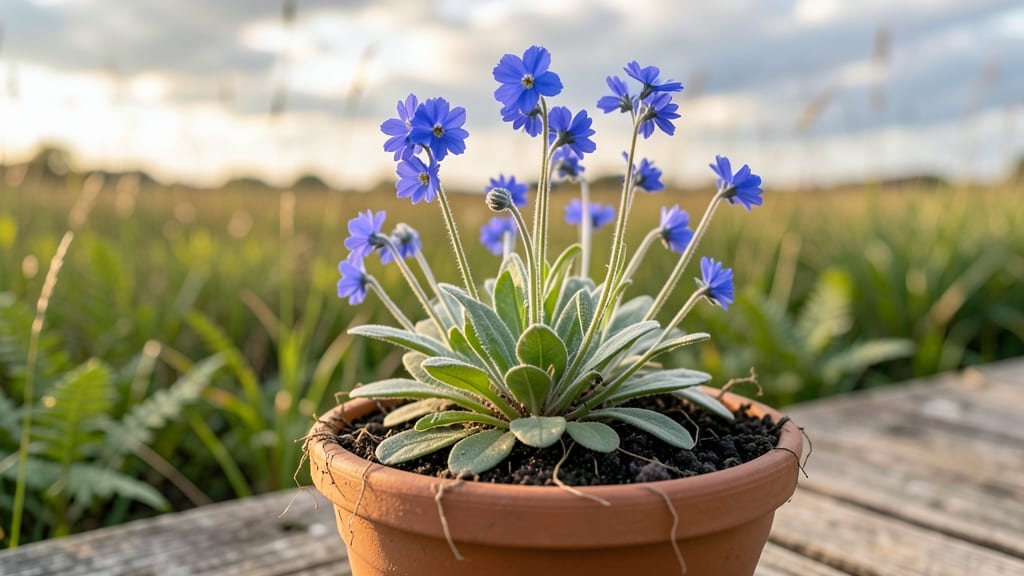
Determining whether forget-me-nots are annual or perennial depends on their seasonal behavior—most die back completely after flowering and don't reliably return, though some varieties may regrow from roots under ideal conditions. Their lifespan is climate-dependent rather than a fixed trait.
Forget-me-nots behave like annuals in most gardens because their above-ground growth dies back completely after blooming, typically in late spring or early summer. 🌱 This isn't due to poor care but rather their natural response to temperature shifts—they store energy in their roots during dormancy.
What's fascinating is that in milder climates (USDA zones 5-8), some varieties naturally regrow from those roots the following spring, creating a partial perennial effect. Think of them as "annuals with a hidden perennial backup plan" rather than true perennials like hostas.
What sets forget-me-nots apart from classic perennials is their sensitivity to cold—even a light frost can trigger full dormancy. Unlike lavender or peonies, which have thick woody stems to survive winter, forget-me-nots rely entirely on their root systems.
This explains why gardeners in colder regions often replant them each year while those in warmer areas might see sporadic regrowth.
💡 In This Article
- Why Forget-Me-Nots Die Back: The Science of Their Growth Cycle
- How to Extend Forget-Me-Not Blooms: Cultivation Tips for Longer-Lived Plants
Why forget-me-nots die back: the science of their growth cycle
Forget-me-nots (Myosotis spp.) undergo complete dieback because their growth is tightly linked to temperature cues rather than inherent perennial traits. These delicate flowers evolved to thrive in temperate climates where summer heat and winter cold create natural dormancy triggers.
When daytime temperatures exceed 75°F for extended periods, their above-ground foliage senesces—meaning the leaves yellow and die as the plant redirects energy to root storage. This process is controlled by phytochrome pigments that detect light quality changes during summer solstice, signaling it's time to "shut down" for survival.
The key difference from true perennials like lavender lies in their root structure. Forget-me-nots develop fibrous roots that store minimal starch reserves (5-10% dry weight) compared to perennials like hostas (which store 20-30%).
Their shallow root systems also lack the protective insulation of deeper perennial roots, making them vulnerable to temperature fluctuations. 🌡️ Even a 28°F frost can trigger full dormancy in some varieties, while others may persist in USDA Zone 5 with proper winter protection.
This explains why they're classified as annuals in most gardening guides—reliability matters more than technical classification.
What's fascinating is their dormancy mechanism: forget-me-nots produce abscisic acid (ABA) during heat stress, which accelerates leaf senescence. This hormone also stimulates root cells to form protective suberin layers, creating a temporary "waterproof" barrier around storage tissues.
Unlike true perennials that maintain some above-ground growth, forget-me-nots go completely dormant, making them appear dead until spring. Their survival strategy mirrors biennials like foxgloves, but without the two-year growth cycle.
Climate plays a crucial role in their behavior. In Zone 7+, some varieties naturally regrow from roots because milder winters prevent complete dormancy. The 'Blue Ball' cultivar, for example, often self-seeds prolifically in these areas, creating the illusion of perennial behavior.
However, this isn't true perennialism—it's simply the plant exploiting favorable conditions rather than having inherent perennial traits. Compare this to peonies, which have thick, fleshy roots designed for winter survival regardless of climate.
The confusion stems from how gardeners perceive "perennial" behavior. While forget-me-nots may return in ideal conditions, their lifespan isn't guaranteed year after year like true perennials. Their growth cycle is more accurately described as "facultative"—capable of behaving as either annual or partial perennial depending on environmental factors.
This adaptability explains why they're so widely grown despite their technical classification as annuals.
Consider this analogy: forget-me-nots are like biennial vegetables (such as carrots) that sometimes produce seed in their first year. They've evolved to maximize reproductive success in unpredictable climates by prioritizing seed production over long-term survival.
This survival strategy makes them excellent candidates for cut flower gardens where annual behavior is actually desirable for consistent blooms.